
Child Guidance Program

The Child Guidance team is here to help families and caregivers address current concerns, understand their child's developmental needs, and encourage nurturing relationships to ensure a healthy future for children, families, and the community.

All families have opportunities to benefit from the clinic-based services offered by the Child Guidance program. Child Guidance provides important and useful information and resources that help guide caregivers to nurture their children’s development.

For a list of some our amazing services, please refer to the services tab to the left. This list is not a comprehensive list of our services provided across the state. Please schedule an appointment with one of our clinicians at your local Child Guidance clinic to best find the services that will meet your family's needs. 

How can the Child Guidance team help?

  • Screen and evaluate a child's skills and abilities. 
  • Identify a child's at-risk behaviors. 
  • Support positive parent-child relationships.
  • Sustain healthy social-emotional development. 
  • Address foster care and adoption challenges.
  • Support communication skills.

Promoting healthy behaviors that strengthen family relationships

  • Manage anger and aggression.
  • Teach caregivers positive parenting skills.
  • Assist children and families with learning skills to cope during hard times.
  • Identify and explain developmental delays. 
  • Provide information on behavior, growth and development. 
  • Coordinate other professional services when needed.

Child Guidance services explained

The Child Guidance program has three professional components designed to provide a continuum of services to build healthy family relationships and enhance child development.

  • Ensure children thrive within relationships through relationship-focused strategies to strengthen infants, toddlers, school-aged children, and their caregivers.
  • Provide individual, family, and group counseling to support behavior change, healing from traumatic experiences, and promote healthy relationships that impact health and well-being across the lifespan.
  • Increase protective factors that buffer against and lessen the impact of Adverse Childhood Experiences (ACEs).
  • Provide trauma-informed and developmentally appropriate strategies to enhance families' ability to provide safe, stable, and nurturing relationships and protective environments.
  • Provide Infant Mental Health assessments and treatment to support early childhood and family well-being.
  • Administer psychosocial and behavioral screenings, assessments, and evaluations of children.
  • Provide evidence-based psycho-educational programs including parenting and children’s groups.
  • Provide Early Childhood Mental Health consultation and other programmatic consultations for childcare centers to build, strengthen, and enhance childcare professionals.
  • Collaborate with community organizations to ensure systems are in place to meet families’ social-emotional needs
  • Consult with community agencies and school systems on behalf of clients and provide special programs as requested.
  • Provide training and consultation to other community professionals including school personnel, Department of Human Services, Early Head Start/Head Start, and other mental health professionals.

Behavioral health services are provided by licensed mental health professionals.

    Speech-Language Pathology staff:

    • Facilitate the early identification of children with a communication delay.
    • Refer children who are eligible for services to the appropriate resource.
    • Train, educate, and consult with parents and professionals on techniques to promote optimal communication development.
    • Provide speech-language pathology evaluation and treatment for children who may not be eligible for other public school or early intervention services.
    • Promote health habits which decrease the likelihood that children will be born with, or acquire, a communication disorder.

    Speech-Language Pathology Services are provided by licensed Speech-Language Pathologists. Target Population: Families with children from birth to 18.

    Child Development services are provided by a Child Development Specialist who holds a master’s degree and a certificate of Certified Child and Parenting Specialist through the Oklahoma Family Resource Coalition. 

    A Child Development Specialist can help you: 

    • Enhance parent-child relationships and the development of young children by providing information and teaching parenting skills to parents of infants, toddlers, and pre-school children.
    • Prevent or reduce developmental problems in young children.
    • Assist with coping strategies and resiliency for families and children experiencing stress.
    • Screen children’s development and provide information to parents regarding developmental strengths and milestones.
    • Assess children’s development by gathering information about the child using an ecological approach of behavior observations; environmental, medical and developmental history; parent-child relationship measures; and standardized developmental assessments. 
    • Provide parent consultation and intervention regarding the child’s development and behavior through individual services, which may include coaching, modeling, providing in-depth information, using reflective practice and training specific parenting skills.
    • Teach evidence-based parent education groups and providing workshops to promote positive parenting, enhance child development and strengthen family interactions.
    • Provide consultation with Early Head Start/Head Start and preschool programs (public and private).
    • Provide various contracted services to Early Head Start/Head Start (where applicable per each county health department).
    • Provide child development trainings that focus on children's social-emotional, cognitive, communication and motor development to childcare programs, Early Head Start/Head Start programs, and preschool programs (public and private).
    • Participate with other health department programs or community organizations to ensure systems are in place to meet families' needs; and
    • Consult with various professionals within and beyond the health department regarding children’s behavior and development, and other parenting concerns.

    Target Population: Families with children from birth through 8 years of age.

    Am I eligible for Child Guidance services?

    • Children birth to age 18, their families, and caregivers are eligible. 
    • Services are provided on a sliding fee scale based on income and the size of the family. Medicaid and some private insurances are accepted.
    • The Child Guidance program is not a crisis intervention facility. For immediate help, please call or text 988 for crisis intervention. 

    How do I contact the Child Guidance team?

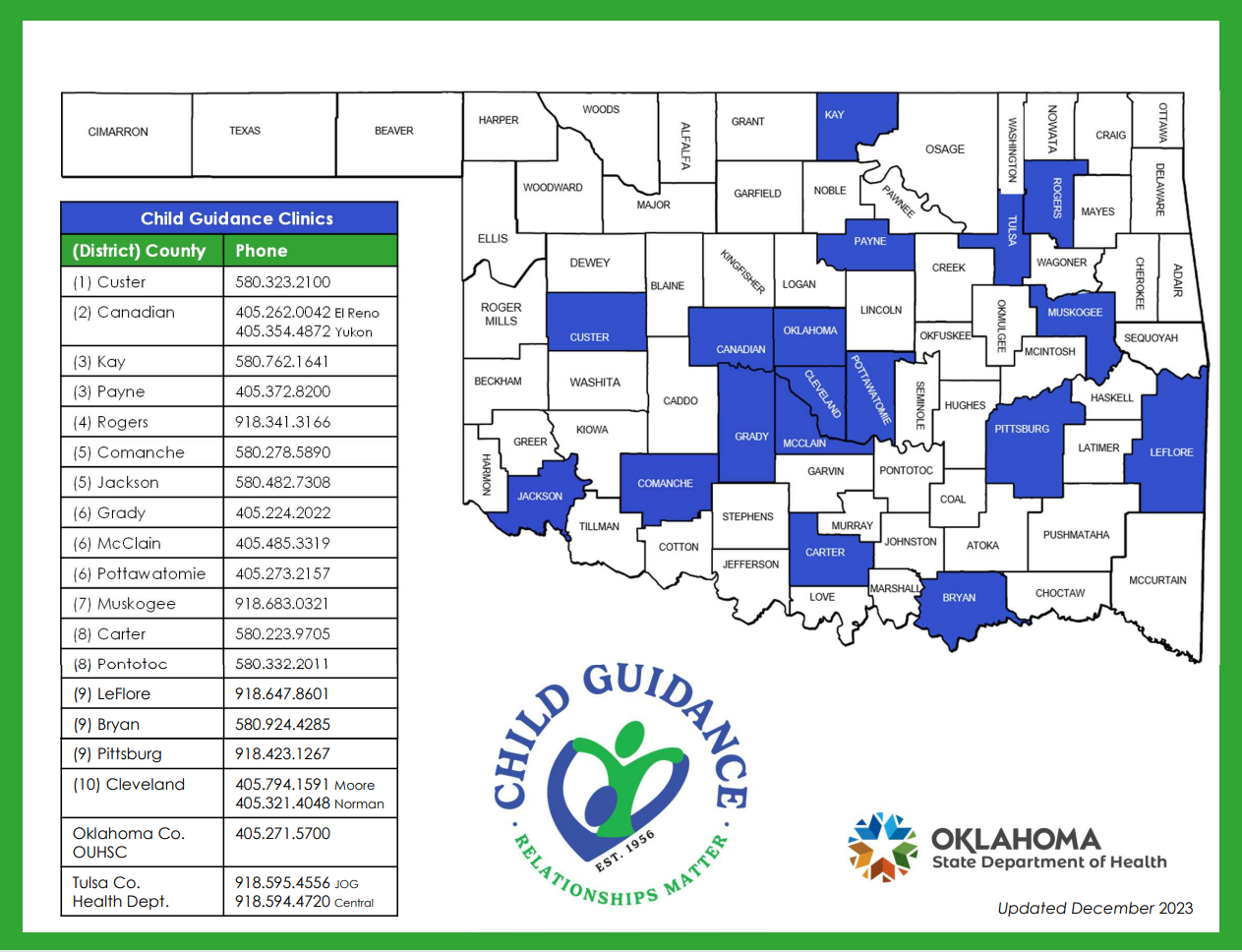
    Child Guidance is available through regional hubs located within local county health departments, and through contracts with the Child Study Center in Oklahoma County and the Tulsa Health Department in Tulsa County. To apply or learn more about child guidance services, please contact Child Guidance at one of the child guidance clinics listed below.

    Child guidance hubs: Cities, counties, phone numbers

    CityCountyPhone number
    AdaPontotoc(580) 332-2011
    AltusJackson(580) 482-7308
    ArdmoreCarter(580) 223-9705
    BlanchardMcClain(405) 485-3319
    ChickashaGrady(405) 224-2022
    ClaremoreRogers(918) 341-3166
    ClintonCuster(580) 323-2100
    DurantBryan(580) 924-4285
    El RenoCanadian(405) 262-0042
    LawtonComanche(580) 278-5890
    McAlesterPittsburg(918) 423-1267
    MooreCleveland(405) 794-1591
    MuskogeeMuskogee(918) 683-0321
    NormanCleveland(405) 321-4048
    Oklahoma CityOklahoma (OUHSC)(405) 271-5700
    Ponca CityKay(580) 762-1641
    PoteauLeFlore(918) 647-8601
    ShawneePottawatomie(405) 273-2157
    StillwaterPayne(405) 372-8200
    TulsaTulsa (Central)(918) 594-4720
    TulsaTulsa (JOG)(918) 595-4556
    YukonCanadian(405) 354-4872

    Contact Information

    Mailing Address:
    Oklahoma State Department of Health
    Allied Health Service
    Child Guidance Program
    123 Robert S. Kerr Ave., Suite 1702
    Oklahoma City, OK 73102-6406

    Physical Location (appointments required):
    Oklahoma State Department of Health
    123 Robert S. Kerr Ave.
    Oklahoma City, OK 73102

    Phone: (405) 426-8100
    Email: ChildGuidance@health.ok.gov